Your Thermostat Says 72. The Back Bedroom Says Otherwise.
It’s the first week of August in Huntsville. The hallway thermostat reads 72 and looks pretty pleased with itself.
Then you open the door to the back bedroom and walk into a warm, sticky wall of air.
Sound familiar? If your house went up before 1980 — Five Points, Blossomwood, Lincoln Mill, the older streets off Governors Drive — you’ve probably been living with this for years. Somebody told you to close the front vents. Somebody else quoted a whole new system without ever going in the crawlspace.
Here’s the thing. What would actually settle this is a full home energy audit, room by room, half a day, real money. You don’t have a Saturday. You have a hot bedroom, a July power bill that made you flinch, and maybe an hour.
So let’s use the hour you already pay for. A good Alabama Climate Control maintenance visit is a small audit if you ask it to be. This article shows you the five numbers it should hand you, and what each one means for your wallet.
Why “It Cools Fine, Mostly” Isn’t Good Enough
Your thermostat is one sensor on one wall, usually in a hallway right next to the return grille. That’s the best-mixed, coolest air in the house.
The system runs until that spot hits 72 and then quits — while a bedroom at the end of a fifty-year-old duct run sits at 79 and climbing.
Now think about where those ducts live. A Huntsville attic runs past 130 degrees in July. The runs to the far bedrooms are the longest ones in the house, they were often sized by rule of thumb instead of calculation, and five decades of storage boxes, blown insulation, and cable installers have not been gentle to them.
That’s not a broken air conditioner. That’s a delivery problem. And the difference matters, because one costs a few hundred dollars and the other costs five figures.
The Standard Nobody Applies to Houses
Let me show you something odd about this industry.
Since 1977, our crews have kept computer rooms, labs, cooling towers, and walk-in coolers across the Tennessee Valley inside tolerance. In those rooms, nobody accepts a thermostat reading as proof. They ask for humidity. Airflow. Static pressure. A logged trend across visits, because drift itself is the failure.
Then that same technician goes to a house and the whole standard evaporates. Filter swapped, coil rinsed, sticker on the unit, see you next year.
Anyone can hit 72. Holding the actual condition of a room is a different job, and it’s the one you’re really asking for. Alabama Climate Control brings the same commercial bench into your driveway, and our technicians work without commission — nobody in your hallway is earning a percentage of what they talk you into.
The Five Numbers to Ask For
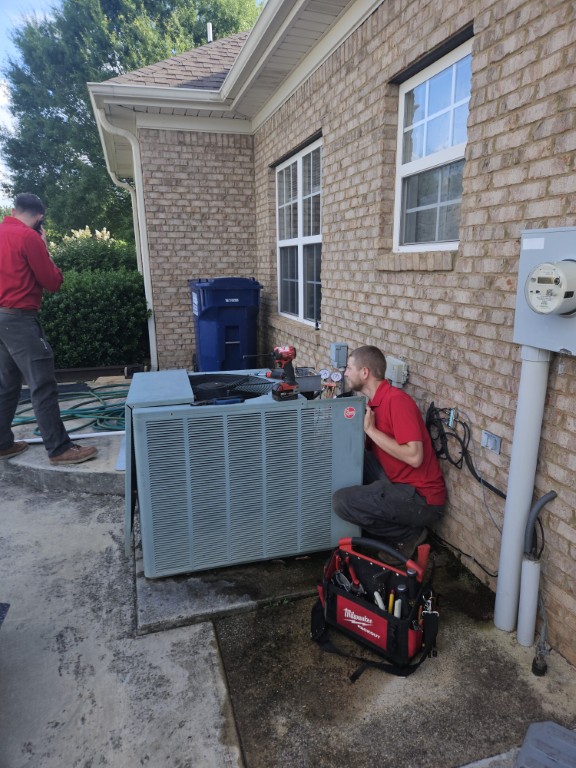
Print this. Hand it to the tech. It takes almost no extra time, and it turns a routine AC maintenance visit into something you can make a decision with.
Number One: Temperature Split at the Air Handler
This is the difference between the air going into your system and the air coming out. On a properly working system it usually lands somewhere around 16 to 22 degrees.
Too small a split means low refrigerant charge, a dirty coil, or airflow trouble. Too large a split often means air is moving too slowly across the coil.
One reading, and you’ve already separated an equipment problem from a duct problem.
Number Two: Room-to-Room Spread
Have the tech take a temperature in the hot bedroom and one at the thermostat, same time, on a hot afternoon.
Three or four degrees is annoying but ordinary. Eight or ten degrees is a real defect, and it will not fix itself.
Write the number down. Next summer, take it again. Two readings a year apart tell you whether things are getting worse — that’s the trend line no sticker on the side of the unit will ever give you.
Number Three: Relative Humidity Indoors
Here’s the one almost nobody measures, and in North Alabama it might be the most important of all.
Our summers run near 80 percent outdoor humidity. If your house sits above 55 percent inside, you’ll feel clammy at 72 and reach for a lower setpoint, which runs the system harder without ever fixing what’s bothering you.
You might feel a little crazy about this. You’re not. You’re feeling moisture, not heat, and a thermostat cannot see moisture at all. This is exactly what the indoor air quality side of the business exists to solve.
Number Four: Static Pressure
Think of it as blood pressure for your duct system. It’s measured at the air handler, and most residential systems are designed for about 0.5 inches of water column.
Plenty of older Huntsville homes measure double that. High static pressure means the blower is fighting the ducts, and that fight shows up as weak airflow in the far rooms, a shortened blower life, and a bigger bill every month.
If a technician has never mentioned this number to you, they have never actually diagnosed your ductwork.
Number Five: A Photograph
Not a number, but worth more than most of them.
Ask for a picture of the duct run feeding the problem room. Crushed under a box. Kinked into an S. Sagging between joists. Disconnected at a boot, dumping your cold air into an attic.
You’d be amazed how often that photo ends the conversation on the spot.
What Your Numbers Probably Mean
| What the readings show | Likely cause | Common in | Typical fix range |
| Normal split, weak airflow in back rooms | Crushed, kinked, or disconnected run | Pre-1980 attic and crawlspace ducts | $300 – $1,500 |
| Normal split, high static pressure | Undersized or restricted duct system | Original 1950s–70s systems | $1,500 – $4,500 |
| Small split, low airflow everywhere | Low charge or dirty evaporator coil | Systems with no service history | $200 – $1,200 |
| Indoor humidity above 55% at setpoint | Oversized equipment, short cycling, no latent capacity | Replacements sized by guess | Assessment first |
| Musty smell, humid, crawlspace ducts | Leaking return pulling in crawlspace air | Vented crawlspace homes | $800 – $3,500 |
| Hot day and night, every season | Room never had capacity designed for it | Additions and converted spaces | Assessment first |
Read that column again. Almost none of those problems live in the box outside.
That’s where the money gets wasted around here. You can spend twelve thousand dollars on a beautiful new system, bolt it to the same tired 1968 ductwork, and that back bedroom will still be warm next July. New equipment, same complaint, empty savings account.
Why 2026 Raises the Stakes
Two things changed, and neither one is in your favor.
The federal 25C tax credit expired December 31, 2025 — up to $2,000 on a qualifying heat pump, gone. And R-410A refrigerant production ended in January 2025, so newer R-454B systems and the refrigerant that goes in them cost noticeably more than they did two years ago.
But here’s what matters. TVA EnergyRight still pays rebates, including money back on tune-ups, duct repair, and high-efficiency equipment. Which means the cheapest comfort available to you right now isn’t a new system at all. It’s the cooling you already bought and never received, because it’s leaking into your attic instead of reaching your kid’s room. Check current offers and rebates before you commit to anything larger.
When This Doesn’t Apply
A few honest exceptions, because you deserve them.
If the hot room is an enclosed porch, a converted garage, or a bonus room over the garage, it may never have had capacity designed for it. No duct repair fixes math. That’s usually a ductless conversation.
If the whole house is uncomfortable rather than one room, this article isn’t your answer — that’s a sizing, charge, or capacity question, and it starts with repair diagnostics.
And if your system is down completely in August with a baby or an elderly parent in the house, close this page and call. Comfort first. Diagnosis second.
Frequently Asked Questions
What should AC maintenance include beyond changing the filter?
A filter swap is housekeeping, not diagnosis. Real ac maintenance produces readings: temperature split at the air handler, static pressure across the blower, indoor relative humidity compared to outdoor conditions, refrigerant charge verified rather than assumed, condensate drain cleared, and a room-by-room temperature check if you have a comfort complaint. Ask for those numbers written on the invoice. If they’re not written down, they can’t be compared next year, and comparison is where the value is.
Can an AC maintenance visit tell me why one bedroom stays hot?
Yes, if the technician measures distribution instead of only servicing equipment. Temperature at the register, static pressure, and a look at the actual duct run will separate a leaking or crushed duct from a heat-gain problem in the room itself. Those two problems feel identical to you and cost very different amounts to fix, so the measurement is what saves the money.
How often does an older Huntsville home need AC maintenance?
Once a year at minimum, ideally spring for cooling and fall for heating. Homes built before 1980 with original ductwork benefit more than newer homes, because duct condition changes over time — joints separate, insulation falls off, crawlspace moisture goes to work. Most manufacturer parts warranties also require documented annual service, so skipping it can quietly cost you coverage you already paid for.
Is duct cleaning the same as duct repair?
No, and the two get confused constantly. Cleaning removes debris and improves what you breathe. Repair and sealing fix leakage, restriction, and bad connections, which is what actually changes the temperature in your back bedroom. Cleaning a leaking duct gives you a clean leak.
Five Numbers Beat a Guess Every Time
You’ve lived with that warm bedroom long enough to assume it’s just how old houses behave. It isn’t.
Split, spread, humidity, static pressure, and one photograph. That’s a diagnosis, and it fits inside a visit you were probably going to schedule anyway.
There’s real relief in hearing that the answer is a $600 duct repair instead of a $12,000 replacement — and in these neighborhoods, that’s how it turns out more often than people expect. Alabama Climate Control has been measuring the Valley’s hardest rooms since 1977, from our Huntsville shop on Wholesale Avenue, with a team that mostly measures its tenure in decades.
Ready to get your five numbers? Schedule a maintenance visit, ask about financing if a bigger fix is coming, and tell the technician which room is the problem before they ever open the truck. Then go stand in that bedroom tonight and notice how it feels. You’re about to find out why.