Why Did My Winter Power Bill Just Double?
It’s January. The house feels fine. Then the power bill shows up, and it’s twice what you paid in October.
Sound familiar?
If you own a heat pump or a dual-fuel system, the cause is often a part you’ve never seen: the backup heat strips. These electric coils sit inside your indoor unit, and they’re meant to help only now and then. When they start running all the time, your bill can climb fast, and nothing about the house will feel different.
Here’s the thing. Most of the time, strips that run too much are a symptom. Something else in the system is off: a setting, a sensor, a dirty coil, or a furnace that isn’t doing its share. Good furnace maintenance finds those problems before your bill does.
In this guide, you’ll learn how backup heat works and what it really costs to run. You’ll also learn the warning signs to check yourself and what a real tune-up should cover for your type of system.
Heat Strips 101: The Expensive Helper You Never Asked For
A heat pump doesn’t burn anything. It moves heat from the outdoor air into your home. That’s why it’s so efficient: it can deliver two to three units of heat for every one unit of electricity it uses.
Heat strips work like a giant toaster. They turn electricity straight into heat, one unit for one unit. No bonus.
So when your thermostat calls on “AUX” or “EM HEAT,” you’re paying full price for every degree.
When Backup Heat Is Supposed to Kick On
Some strip use is normal. Your system should use backup heat in three situations.
The first is defrost. In cold, damp weather, frost builds up on the outdoor coil. The heat pump briefly reverses to melt it, and the strips warm the air so you don’t get a cold blast.
The second is a deep cold snap. Once it gets well below freezing, many heat pumps can’t keep up alone, so the strips fill the gap.
The third is a big temperature jump. If you bump the thermostat up five degrees, many thermostats call in the strips to get there faster.
But here’s what matters. In North Alabama, true deep-freeze days are pretty rare. If your strips run on a 40-degree afternoon, something is wrong.
What Backup Heat Really Costs
Look, numbers make this real. The table below compares the cost of producing about the same amount of heat (roughly 34,000 BTUs, enough for one hour of steady heating in a mid-sized home) with each heat source.
We assumed electricity at about 13 cents per kWh and natural gas at about $1.50 per therm. Your rates will differ, so check your own bills and adjust.
| Heat Source | How It Makes Heat | Efficiency | Approx. Cost Per Hour |
| Heat pump (mild weather, 40°F+) | Moves heat from outdoor air | 250–350% | $0.40–$0.55 |
| Heat pump (near freezing) | Moves heat, works harder | 175–225% | $0.60–$0.75 |
| Gas furnace (95% AFUE) | Burns natural gas | 95% | About $0.55 |
| Gas furnace (80% AFUE, older) | Burns natural gas | 80% | About $0.65 |
| 10 kW electric heat strips | Electric resistance | 100% | About $1.30 |
| 15 kW electric heat strips | Electric resistance | 100% | About $1.95 |
See the gap? Strip heat can cost two to three times as much as your heat pump. If your strips quietly run four extra hours a day all winter, that can add up to more than $150 a month.
That’s frustrating. And it’s often fixable.
Seven Reasons Your Strips Won’t Quit
After decades of winter service calls across the Tennessee Valley, our techs see the same culprits again and again. Some are simple. Others need a trained eye.
1. The Thermostat Is Set Up Wrong
This one surprises people. Many thermostats have a setting called “aux heat lockout” or “balance point.” It tells the system when backup heat may run.
If it was never set, or was set wrong at install, the strips can turn on at almost any outdoor temperature. A smart thermostat installed by a homeowner is a common example. The wiring works, but the heat-pump settings were never tuned.
2. Big Nighttime Setbacks
Dropping the heat to 62 at night sounds thrifty. With a heat pump, it can backfire. When you crank it back to 70 at 6 a.m., the thermostat sees an eight-degree gap and calls in the strips to close it.
The fix is small setbacks of two to three degrees, or a thermostat with “smart recovery” that warms the house slowly.
3. A Dirty Filter or Coil
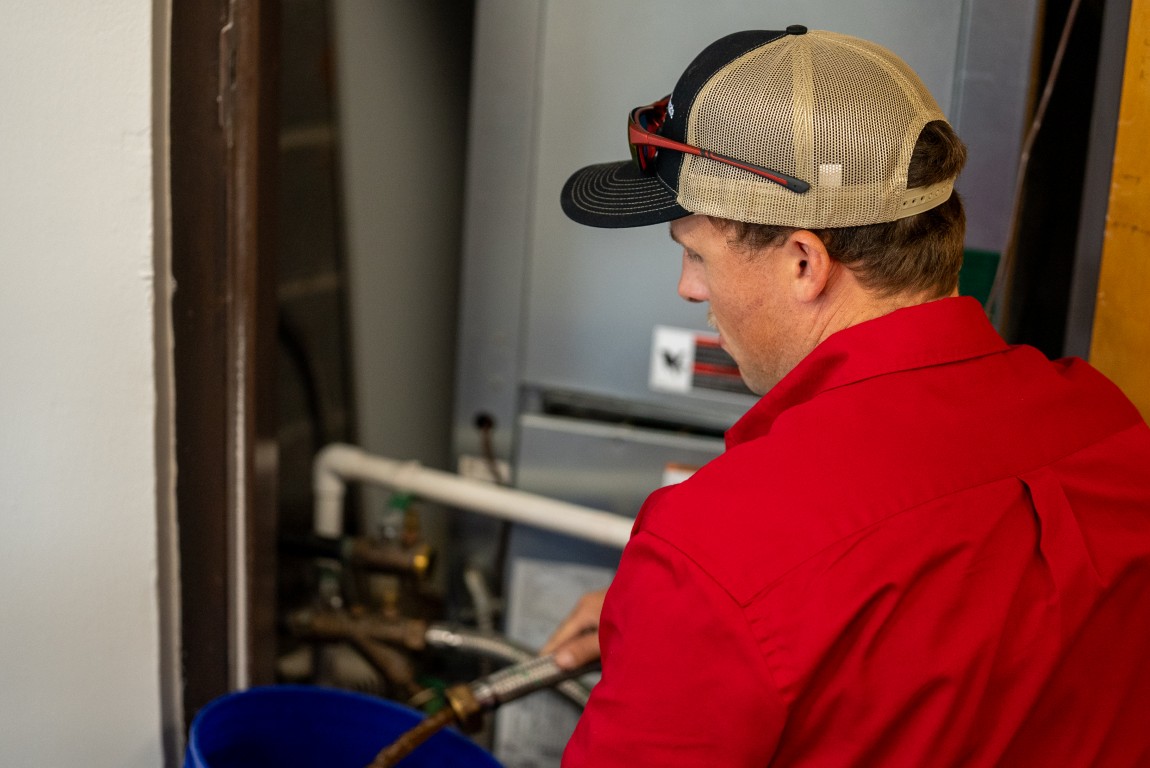
A clogged filter chokes airflow. Less airflow means less heat moved, so the house warms slowly and the thermostat calls for help. A dirty indoor or outdoor coil does the same thing.
4. Low Refrigerant
Refrigerant is what carries heat into your home. If there’s a leak, the heat pump gets weaker every week. You may not notice, because the strips quietly pick up the slack. Your bill notices.
5. A Failing Defrost Board or Sensor
If the defrost control sticks, the system can stay in defrost far too long, running the strips the whole time. If it never defrosts, the outdoor coil turns into a block of ice, and the strips end up doing all the work.
6. Emergency Heat Was Left On
It happens more than you’d think. Someone flips to “EM HEAT” during a cold night or a repair visit and forgets. Now the heat pump is off and the house is heating on strips alone.
7. The Dual-Fuel Changeover Is Off
Dual-fuel owners have a different version of this problem. Your system switches from the heat pump to the gas furnace at a set outdoor temperature. Set that point too high, and you burn gas when the heat pump would be cheaper. Set it too low, and the heat pump struggles in the cold.
Some dual-fuel systems also have backup strips. If the furnace has a problem, those strips may be covering for it without you knowing.
The Exception: When Strip Heat Is the Right Call
This doesn’t mean strips are always bad. They’re a safety net.
If your outdoor unit fails on a 20-degree night, emergency heat keeps your pipes from freezing and your family warm. Use it. Then call for heating repair soon, because running on strips alone for a week is a costly way to wait.
Also, some older or undersized heat pumps truly can’t keep up on cold days. In that case, maintenance helps, but it can’t fix a capacity problem. A straight answer about whether repair or replacement makes sense is worth getting before you spend money either way.
What Real Furnace Maintenance Covers for Heat Pump and Dual-Fuel Systems
Here’s where a lot of homeowners get shortchanged. A “tune-up” that only swaps the filter and checks the thermostat misses the stuff that drives your bill.
For a heat pump with electric strips, a thorough visit should include measuring the amp draw on each strip and checking that the sequencers turn them on in stages, not all at once. The tech should also test the defrost board and sensor and check refrigerant pressures and temperatures. Cleaning the coils and confirming the thermostat’s aux lockout and staging settings should be on the list too.
For a dual-fuel system, add the gas side. That means checking the flame sensor and ignitor, the inducer motor, the burners, and the heat exchanger for cracks. It also means a carbon monoxide test and a look at the changeover temperature to make sure it fits your local energy prices.
You can see the full checklist on our furnace maintenance page.
Why Fall Is the Best Time
Want to know the secret? Book before the first cold snap.
In October and November, there’s time to find a slow refrigerant leak or a weak defrost sensor before it costs you. Wait until January, and you’re calling on the busiest days of the year, with the strips already running up your bill.
Many homeowners pair their heating visit with spring AC maintenance, since a heat pump is one machine doing two jobs. A preventative maintenance plan keeps both on schedule.
Quick Checks You Can Do This Weekend
You don’t need tools for these. Just a few minutes.
First, look at your thermostat while the heat is running. Does it say “AUX” or “EM”? If it shows that often on mild days, write down the outdoor temperature and the time. That’s useful info for a tech.
Next, walk outside. Is the outdoor unit running when the heat is on? If the fan is still and the house is heating, you may be on strips alone.
Check your filter, too. If you can’t see light through it, change it. Then clear leaves, pine straw, and mulch at least two feet back from the outdoor unit.
Finally, compare this January’s kWh use with last January’s on your utility bill. A big jump in similar weather is a red flag.
Why the Advice You Get Matters as Much as the Repair
You might feel overwhelmed by all this. And it’s easy to worry that a tech will look at a strip problem and say, “You need a whole new system.”
Sometimes that’s true. Often it isn’t. A $200 defrost sensor or a thermostat setting can stop the bleeding.
At Alabama Climate Control, our technicians don’t earn commission. They’re paid to fix, not to sell. So when they look at your heat pump or dual-fuel system, the only reason they’d recommend a replacement is that your home truly needs one. If a repair makes more sense, you’ll hear that, with the numbers laid out so you can decide.
That matters a lot for Huntsville-area homeowners who like to see the data first. Many of our techs have been with us for 15 years or more, and Alabama Climate Control has served North Alabama since 1977. You can learn more about our team on our Who We Are page.
If a replacement does make sense, we’ll walk you through heating installation options and financing options. And if poor airflow is part of the problem, our ductwork design and installation team can fix the root cause.
Frequently Asked Questions
Do heat pumps need furnace maintenance if there’s no furnace?
Yes. Your indoor unit has a blower, heat strips, and controls that do the furnace’s job. A tune-up checks strip amp draw, the defrost controls, and refrigerant charge. Those three items have the biggest effect on whether your strips run more than they should.
How can I tell if my heat strips are running too much?
Watch for “AUX” on the thermostat when it’s above about 35°F outside, a winter bill far higher than last year’s in similar weather, or an outdoor unit that isn’t running while heat comes from the vents. Any of these is worth a service visit.
What’s the best changeover temperature for a dual-fuel system in North Alabama?
It depends on your gas and electric rates, your heat pump’s efficiency, and your home. Many systems in our area land somewhere between 30°F and 40°F. A tech should set it from your actual utility rates, not a factory default.
How often should I schedule furnace maintenance for a heat pump?
Twice a year: once in the fall for heating and once in spring for cooling. A heat pump runs in both seasons, so it wears faster than a furnace that only works in winter.
Stop Paying the Strip Heat Tax This Winter
Heat strips are a backup, not a main heat source. When they run all the time, the real cause is usually a thermostat setting, a dirty coil, low refrigerant, a failing defrost part, or a dual-fuel changeover set wrong. All of these are things fall furnace maintenance is meant to catch.
Do the quick checks this weekend. Write down what you see. Then get a straight answer from someone with no reason to oversell you.
Ready to find out what’s driving your winter bill? Book a heating tune-up with Alabama Climate Control or call (256) 979-0618. And if your strips are running right now, don’t wait for the next bill. Schedule furnace maintenance today.